from toolz.curried import *

import pandas as pd
import numpy as np

import statsmodels.formula.api as smf

from matplotlib import pyplot as plt
from cycler import cycler

color = ["0.0", "0.4", "0.8"]
default_cycler = cycler(color=color)
linestyle = ["-", "--", ":", "-."]
marker = ["o", "v", "d", "p"]

plt.rc("axes", prop_cycle=default_cycler)10장 - 지역 실험과 스위치백 실험
from sklearn.base import BaseEstimator, RegressorMixin
from sklearn.utils.validation import check_X_y, check_array, check_is_fitted
import cvxpy as cp


class SyntheticControl(BaseEstimator, RegressorMixin):
    def __init__(self, fit_intercept=False):
        self.fit_intercept = fit_intercept

    def fit(self, y_pre_co, y_pre_tr):
        y_pre_co, y_pre_tr = check_X_y(y_pre_co, y_pre_tr)

        # add intercept
        intercept = np.ones((y_pre_co.shape[0], 1)) * self.fit_intercept
        X = np.concatenate([intercept, y_pre_co], axis=1)
        w = cp.Variable(X.shape[1])

        objective = cp.Minimize(cp.sum_squares(X @ w - y_pre_tr))
        constraints = [cp.sum(w[1:]) == 1, w[1:] >= 0]

        problem = cp.Problem(objective, constraints)

        self.loss_ = problem.solve(eps_abs=1)
        self.w_ = w.value[1:]
        self.intercept_ = w.value[0]

        self.is_fitted_ = True
        return self

    def predict(self, y_co):
        check_is_fitted(self)
        y_co = check_array(y_co)

        return y_co @ self.w_ + self.intercept_
10.1 지역 실험
지역 기반의 실험 설계를 통해 간섭 효과(Interference) 문제를 해결할 수 있습니다.
df = (
    pd.read_csv("../data/online_mkt.csv")
    .astype({"date": "datetime64[ns]"})
    .query("post==0")
)

df.head()| app_download | population | city | state | date | post | treated | |
|---|---|---|---|---|---|---|---|
| 0 | 3066.0 | 12396372 | sao_paulo | sao_paulo | 2022-03-01 | 0 | 1 |
| 1 | 2701.0 | 12396372 | sao_paulo | sao_paulo | 2022-03-02 | 0 | 1 |
| 2 | 1927.0 | 12396372 | sao_paulo | sao_paulo | 2022-03-03 | 0 | 1 |
| 3 | 1451.0 | 12396372 | sao_paulo | sao_paulo | 2022-03-04 | 0 | 1 |
| 4 | 1248.0 | 12396372 | sao_paulo | sao_paulo | 2022-03-05 | 0 | 1 |
detectable_diff = df["app_download"].mean() * 0.05
sigma_2 = df.groupby("city")["app_download"].mean().var()

np.ceil((sigma_2 * 16) / (detectable_diff) ** 2)36663.010.2 통제집단합성법 설계
pd.set_option("display.max_columns", 6)df_piv = df.pivot("date", "city", "app_download")
df_piv.head()| city | ananindeua | aparecida_de_goiania | aracaju | ... | teresina | uberlandia | vila_velha |
|---|---|---|---|---|---|---|---|
| date | |||||||
| 2022-03-01 | 11.0 | 54.0 | 65.0 | ... | 68.0 | 29.0 | 63.0 |
| 2022-03-02 | 5.0 | 20.0 | 42.0 | ... | 17.0 | 29.0 | 11.0 |
| 2022-03-03 | 2.0 | 0.0 | 0.0 | ... | 55.0 | 30.0 | 14.0 |
| 2022-03-04 | 0.0 | 0.0 | 11.0 | ... | 49.0 | 35.0 | 0.0 |
| 2022-03-05 | 5.0 | 5.0 | 0.0 | ... | 31.0 | 6.0 | 1.0 |
5 rows × 50 columns
f = (
    df.groupby("city")["population"].first()
    / df.groupby("city")["population"].first().sum()
)plt.figure(figsize=(12, 3))
plt.bar(f.sort_values().index, f.sort_values().values)
plt.title("Size of each city as a proportional of the market (f vector)")
plt.xticks(rotation=90, fontsize=14);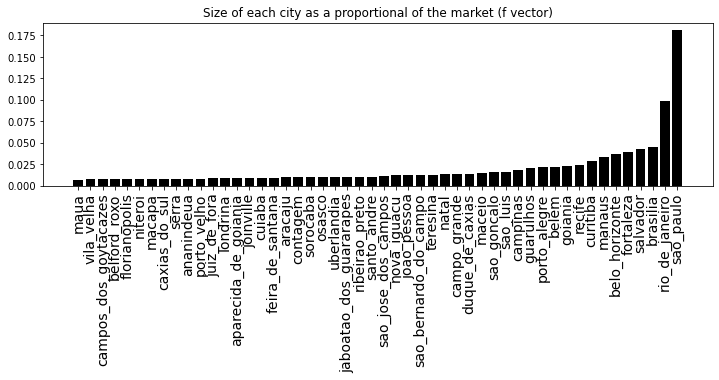
10.2.1 무작위로 실험군 선택하기
y_avg = df_piv.dot(f)
geos = list(df_piv.columns)
n_tr = 5np.random.seed(42)
rand_geos = np.random.choice(geos, n_tr, replace=False)
rand_geosarray(['manaus', 'recife', 'sao_bernardo_do_campo', 'salvador', 'aracaju'],
dtype='<U23')def get_sc(geos, df_sc, y_mean_pre):
model = SyntheticControl(fit_intercept=True)
model.fit(df_sc[geos], y_mean_pre)
selected_geos = geos[np.abs(model.w_) > 1e-5]
return {"geos": selected_geos, "loss": model.loss_}
get_sc(rand_geos, df_piv, y_avg){'geos': array(['salvador', 'aracaju'], dtype='<U23'),
'loss': 1598616.80875266}def get_sc_st_combination(treatment_geos, df_sc, y_mean_pre):
treatment_result = get_sc(treatment_geos, df_sc, y_mean_pre)
remaining_geos = df_sc.drop(columns=treatment_result["geos"]).columns
control_result = get_sc(remaining_geos, df_sc, y_mean_pre)
return {
"st_geos": treatment_result["geos"],
"sc_geos": control_result["geos"],
"loss": treatment_result["loss"] + control_result["loss"],
}
resulting_geos = get_sc_st_combination(rand_geos, df_piv, y_avg)resulting_geos.get("st_geos")array(['salvador', 'aracaju'], dtype='<U23')len(resulting_geos.get("st_geos")) + len(resulting_geos.get("sc_geos"))50synthetic_tr = SyntheticControl(fit_intercept=True)
synthetic_co = SyntheticControl(fit_intercept=True)
synthetic_tr.fit(df_piv[resulting_geos.get("st_geos")], y_avg)
synthetic_co.fit(df_piv[resulting_geos.get("sc_geos")], y_avg)
plt.figure(figsize=(10, 4))
plt.plot(y_avg, label="Average")
plt.plot(
y_avg.index,
synthetic_co.predict(df_piv[resulting_geos.get("sc_geos")]),
label="sc",
ls=":",
)
plt.plot(
y_avg.index, synthetic_tr.predict(df_piv[resulting_geos.get("st_geos")]), label="st"
)
plt.xticks(rotation=45)
plt.legend()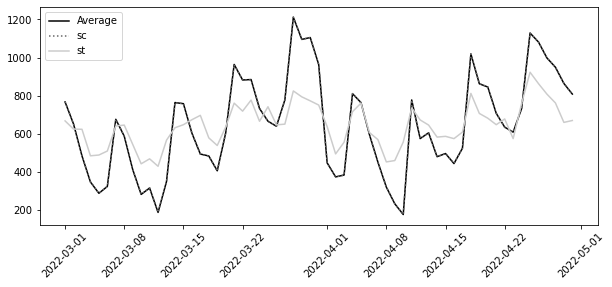
10.2.2 무작위 탐색
from joblib import Parallel, delayed
from toolz import partial

np.random.seed(42)
geo_samples = [np.random.choice(geos, n_tr, replace=False) for _ in range(1000)]

est_combination = partial(get_sc_st_combination, df_sc=df_piv, y_mean_pre=y_avg)

results = Parallel(n_jobs=4)(delayed(est_combination)(geos) for geos in geo_samples)
resulting_geos = min(results, key=lambda x: x.get("loss"))
resulting_geos.get("st_geos")array(['nova_iguacu', 'belem', 'joinville', 'sao_paulo'], dtype='<U23')synthetic_tr = SyntheticControl(fit_intercept=True)
synthetic_co = SyntheticControl(fit_intercept=True)
synthetic_tr.fit(df_piv[resulting_geos.get("st_geos")], y_avg)
synthetic_co.fit(df_piv[resulting_geos.get("sc_geos")], y_avg)
plt.figure(figsize=(10, 4))
plt.plot(y_avg, label="Average")
plt.plot(
y_avg.index,
synthetic_co.predict(df_piv[resulting_geos.get("sc_geos")]),
label="sc",
ls=":",
)
plt.plot(
y_avg.index, synthetic_tr.predict(df_piv[resulting_geos.get("st_geos")]), label="st"
)
plt.xticks(rotation=45)
plt.legend()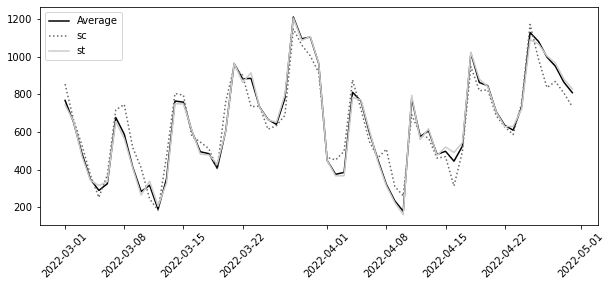
10.3 스위치백 실험
df = pd.read_csv("../data/sb_exp_every.csv")
df.head()| d | delivery_time | delivery_time_1 | delivery_time_0 | tau | |
|---|---|---|---|---|---|
| 0 | 1 | 2.84 | 2.84 | 5.84 | -3.0 |
| 1 | 0 | 4.49 | 1.49 | 6.49 | -5.0 |
| 2 | 0 | 7.27 | 2.27 | 8.27 | -6.0 |
| 3 | 1 | 5.27 | 2.27 | 8.27 | -6.0 |
| 4 | 1 | 5.59 | 4.59 | 10.59 | -6.0 |
plt.figure(figsize=(12, 5))
x = df.index
plt.plot(x, df["delivery_time_0"], ls=":", color="0.0", label="Y0")
plt.plot(x, df["delivery_time_1"], ls=":", color="0.8", label="Y1")
plt.plot(x, df["delivery_time"], color="0.4", label="Y")
plt.scatter(
    x[df["d"] == 1],
    df["delivery_time"][df["d"] == 1],
    label="Treated",
    marker="v",
    color="0.4",
)
plt.scatter(
    x[df["d"] == 0],
    df["delivery_time"][df["d"] == 0],
    label="Control",
    marker="o",
    color="0.4",
)
plt.ylabel("delivery_time")
plt.xlabel("Hours")
plt.legend(fontsize=14)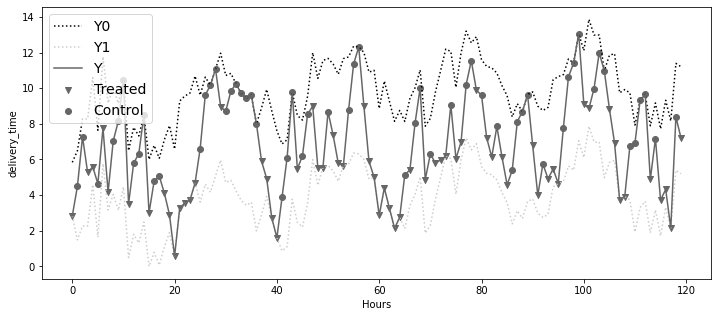
10.3.1 시퀀스의 잠재적 결과
10.3.2 이월 효과의 차수 추정
df_lags = df.assign(**{f"d_l{l}": df["d"].shift(l) for l in range(7)})

df_lags[[f"d_l{l}" for l in range(7)]].head()| d_l0 | d_l1 | d_l2 | ... | d_l4 | d_l5 | d_l6 | |
|---|---|---|---|---|---|---|---|
| 0 | 1 | NaN | NaN | ... | NaN | NaN | NaN |
| 1 | 0 | 1.0 | NaN | ... | NaN | NaN | NaN |
| 2 | 0 | 0.0 | 1.0 | ... | NaN | NaN | NaN |
| 3 | 1 | 0.0 | 0.0 | ... | NaN | NaN | NaN |
| 4 | 1 | 1.0 | 0.0 | ... | 1.0 | NaN | NaN |
5 rows × 7 columns
model = smf.ols(
    "delivery_time ~" + "+".join([f"d_l{l}" for l in range(7)]), data=df_lags
).fit()

model.summary().tables[1]| coef | std err | t | P>|t| | [0.025 | 0.975] | |
|---|---|---|---|---|---|---|
| Intercept | 9.3270 | 0.461 | 20.246 | 0.000 | 8.414 | 10.240 |
| d_l0 | -2.9645 | 0.335 | -8.843 | 0.000 | -3.629 | -2.300 |
| d_l1 | -1.8861 | 0.339 | -5.560 | 0.000 | -2.559 | -1.213 |
| d_l2 | -1.0013 | 0.340 | -2.943 | 0.004 | -1.676 | -0.327 |
| d_l3 | 0.2594 | 0.341 | 0.762 | 0.448 | -0.416 | 0.935 |
| d_l4 | 0.1431 | 0.340 | 0.421 | 0.675 | -0.531 | 0.817 |
| d_l5 | 0.1388 | 0.340 | 0.408 | 0.684 | -0.536 | 0.813 |
| d_l6 | 0.5588 | 0.336 | 1.662 | 0.099 | -0.108 | 1.225 |
## remember to remove the intercept
tau_m_hat = model.params[1:].sum()
se_tau_m_hat = np.sqrt((model.bse[1:] ** 2).sum())
print("tau_m:", tau_m_hat)
print("95% CI:", [tau_m_hat - 1.96 * se_tau_m_hat, tau_m_hat + 1.96 * se_tau_m_hat])
tau_m: -4.751686115272022
95% CI: [-6.5087183781545574, -2.9946538523894857]## selecting lags 0, 1 and 2
tau_m_hat = model.params[1:4].sum()
se_tau_m_hat = np.sqrt((model.bse[1:4] ** 2).sum())
print("tau_m:", tau_m_hat)
print("95% CI:", [tau_m_hat - 1.96 * se_tau_m_hat, tau_m_hat + 1.96 * se_tau_m_hat])tau_m: -5.8518568954422925
95% CI: [-7.000105171362163, -4.703608619522422]10.3.3 디자인 기반의 추정
rad_points_3 = np.array([True, False, False] * (2))
rad_points_3
array([ True, False, False, True, False, False])rad_points_3.cumsum()array([1, 1, 1, 2, 2, 2])from numpy.lib.stride_tricks import sliding_window_view
m = 2
sliding_window_view(rad_points_3.cumsum(), window_shape=m + 1)array([[1, 1, 1],
[1, 1, 2],
[1, 2, 2],
[2, 2, 2]])np.diff(sliding_window_view(rad_points_3.cumsum(), 3), axis=1)array([[0, 0],
[0, 1],
[1, 0],
[0, 0]])n_rand_windows = np.concatenate(
[
[np.nan] * m,
np.diff(sliding_window_view(rad_points_3.cumsum(), 3), axis=1).sum(axis=1) + 1,
]
)
n_rand_windowsarray([nan, nan, 1., 2., 2., 1.])p = 0.5
p**n_rand_windowsarray([ nan, nan, 0.5 , 0.25, 0.25, 0.5 ])def compute_p(rand_points, m, p=0.5):
n_windows_last_m = np.concatenate(
[
[np.nan] * m,
np.diff(sliding_window_view(rand_points.cumsum(), m + 1), axis=1).sum(
axis=1
)
+ 1,
]
)
return p**n_windows_last_m
compute_p(np.ones(6) == 1, 2, 0.5)array([ nan, nan, 0.125, 0.125, 0.125, 0.125])rand_points = np.array([True, False, False, True, False, True, False])
compute_p(rand_points, 2, 0.5)array([ nan, nan, 0.5 , 0.25, 0.25, 0.25, 0.25])def last_m_d_equal(d_vec, d, m):
return np.concatenate(
[[np.nan] * m, (sliding_window_view(d_vec, m + 1) == d).all(axis=1)]
)
print(last_m_d_equal([1, 1, 1, 0, 0, 0], 1, m=2))
print(last_m_d_equal([1, 1, 1, 0, 0, 0], 0, m=2))[nan nan 1. 0. 0. 0.]
[nan nan 0. 0. 0. 1.]def ipw_switchback(d, y, rand_points, m, p=0.5):
p_last_m_equal_1 = compute_p(rand_points, m=m, p=p)
p_last_m_equal_0 = compute_p(rand_points, m=m, p=1 - p)
last_m_is_1 = last_m_d_equal(d, 1, m)
last_m_is_0 = last_m_d_equal(d, 0, m)
y1_rec = y * last_m_is_1 / p_last_m_equal_1
y0_rec = y * last_m_is_0 / p_last_m_equal_0
return np.mean((y1_rec - y0_rec)[m:])ipw_switchback(df["d"], df["delivery_time"], np.ones(len(df)) == 1, m=2, p=0.5)-7.426440677966101from matplotlib import pyplot as plt
from statsmodels.tsa.arima_process import ArmaProcess
def gen_d(rand_points, p):
result = [np.random.binomial(1, p)]
for t in rand_points[1:]:
result.append(np.random.binomial(1, p) * t + (1 - t) * result[-1])
return np.array(result)
def y_given_d(d, effect_params, T, seed=None):
np.random.seed(seed) if seed is not None else None
x = np.arange(1, T + 1)
return (
np.log(x + 1)
+ 2 * np.sin(x * 2 * np.pi / 24)
+ np.convolve(~d.astype(bool), effect_params)[: -(len(effect_params) - 1)]
+ ArmaProcess([3, 2, 1], 12).generate_sample(T)
).round(2)
def gen_data_rand_every():
effect_params = [3, 2, 1]
T = 120
p = 0.5
m = 2
d = np.random.binomial(1, 0.5, T)
y = y_given_d(d, [3, 2, 1], T)
rand_points = np.ones(T) == 1
return pd.DataFrame(dict(d=d, y=y, rand_points=rand_points))
def tau_ols(df):
df_lags = df.assign(**{f"d_l{l}": df["d"].shift(l) for l in range(3)})
model = smf.ols("y ~" + "+".join([f"d_l{l}" for l in range(3)]), data=df_lags).fit()
return model.params[1:].sum()
def tau_ipw(df):
return ipw_switchback(df["d"], df["y"], df["rand_points"], m=2, p=0.5)
np.random.seed(123)
exps_dfs = [gen_data_rand_every() for _ in range(500)]
fig, (ax1, ax2) = plt.subplots(2, 1, sharex=True, figsize=(8, 4))
ols_taus = list(map(tau_ols, exps_dfs))
ax1.hist(ols_taus, label="OLS tau", color="0.5")
ax1.vlines(-6, 0, 120, color="0", label="True tau")
ax1.legend()
ipw_taus = list(map(tau_ipw, exps_dfs))
ax2.hist(ipw_taus, label="IPW tau", color="0.5")
ax2.vlines(-6, 0, 120, color="0")
ax2.legend()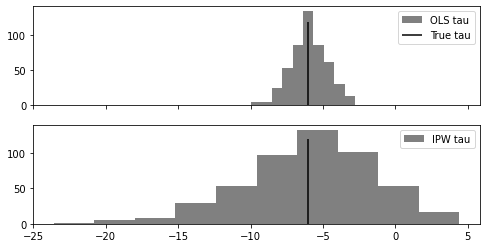
10.3.4 최적의 스위치백 설계
m = 2
T = 12
n = T / m
np.isin(np.arange(1, T + 1), [1] + [i * m + 1 for i in range(2, int(n) - 1)]) * 1
array([1, 0, 0, 0, 1, 0, 1, 0, 1, 0, 0, 0])m = 3
T = 15
n = T / m
np.isin(np.arange(1, T + 1), [1] + [i * m + 1 for i in range(2, int(n) - 1)]) * 1array([1, 0, 0, 0, 0, 0, 1, 0, 0, 1, 0, 0, 0, 0, 0])def gen_d(rand_points, p):
result = [np.random.binomial(1, p)]
for t in rand_points[1:]:
result.append(np.random.binomial(1, p) * t + (1 - t) * result[-1])
return np.array(result)
T = 120
m = 2
def gen_exp(rand_points, T):
effect_params = [3, 2, 1]
p = 0.5
d = gen_d(rand_points, p=p)
y = y_given_d(d, [3, 2, 1], T)
return pd.DataFrame(dict(d=d, y=y, rand_points=rand_points))
every_1 = np.array([True] * T)
every_3 = np.array([True, False, False] * (T // 3))
n = T // m
opt = np.isin(np.arange(1, T + 1), [1] + [i * m + 1 for i in range(2, int(n) - 1)])
np.random.seed(123)
exps_every_1 = [gen_exp(every_1, T) for _ in range(1000)]
exps_every_3 = [gen_exp(every_3, T) for _ in range(1000)]
exps_opt = [gen_exp(opt, T) for _ in range(1000)]fig, axs = plt.subplots(3, 1, sharex=True, figsize=(12, 6))
ax1, ax2, ax3 = axs.ravel()
taus_every_1_ipw = list(map(tau_ipw, exps_every_1))
ax1.hist(taus_every_1_ipw, label="Every Period", color="0.5")
ax1.set_title(f"Var={np.round(np.var(taus_every_1_ipw), 2)}")
ax1.legend()
taus_every_3_ipw = list(map(tau_ipw, exps_every_3))
ax2.hist(taus_every_3_ipw, label="Every 3 Periods", color="0.5")
ax2.set_title(f"Var={np.round(np.var(taus_every_3_ipw), 2)}")
ax2.legend()
taus_opt_ipw = list(map(tau_ipw, exps_opt))
ax3.hist(taus_opt_ipw, label="Optimal Design", color="0.5")
ax3.set_title(f"Var={np.round(np.var(taus_opt_ipw), 2)}")
ax3.legend()
plt.tight_layout()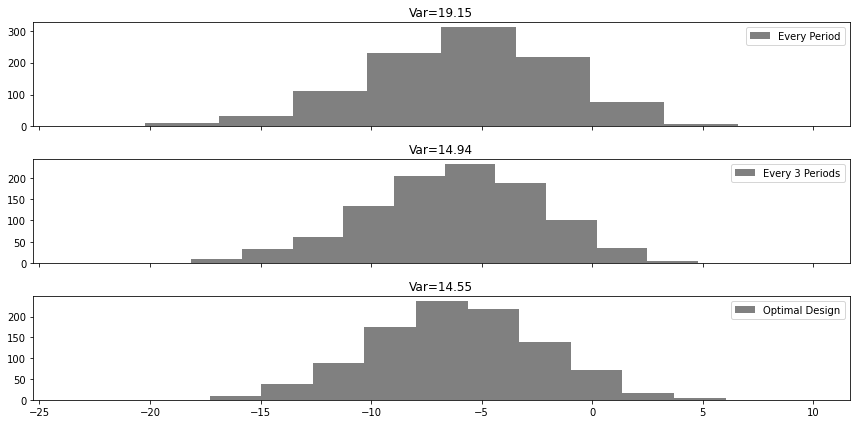
10.3.5 강건한 분산
df_opt = pd.read_csv("../data/sb_exp_opt.csv")
df_opt.head(6)| rand_points | d | delivery_time | |
|---|---|---|---|
| 0 | True | 0 | 5.84 |
| 1 | False | 0 | 5.40 |
| 2 | False | 0 | 8.86 |
| 3 | False | 0 | 8.79 |
| 4 | True | 0 | 10.93 |
| 5 | False | 0 | 7.02 |
tau_hat = ipw_switchback(
    df_opt["d"], df_opt["delivery_time"], df_opt["rand_points"], m=2, p=0.5
)

tau_hat-9.921016949152545np.vstack(np.hsplit(np.array([1, 1, 1, 2, 2, 3]), 3))array([[1, 1],
[1, 2],
[2, 3]])np.diff(np.vstack(np.hsplit(np.array([1, 1, 0, 0, 0, 0]), 3))[:, 0]) == 0array([False, True])def var_opt_design(d_opt, y_opt, T, m):
assert (T // m == T / m) & (T // m >= 4), "T must be divisible by m and T/m >= 4"
# discard 1st block
y_m_blocks = np.vstack(np.hsplit(y_opt, int(T / m))).sum(axis=1)[1:]
# take 1st column
d_m_blocks = np.vstack(np.split(d_opt, int(T / m))[1:])[:, 0]
return (
8 * y_m_blocks[0] ** 2
+ (32 * y_m_blocks[1:-1] ** 2 * (np.diff(d_m_blocks) == 0)[:-1]).sum()
+ 8 * y_m_blocks[-1] ** 2
) / (T - m) ** 2se_hat = np.sqrt(var_opt_design(df_opt["d"], df_opt["delivery_time"], T=120, m=2))
[tau_hat - 1.96 * se_hat, tau_hat + 1.96 * se_hat][-18.490627362048095, -1.351406536256997]